
For years, outsourcing development work meant looking overseas to regions like Eastern Europe or Asia.
Lower costs made it appealing.
But today, many U.S. and Canadian tech companies are rethinking that model.
Because while cost still matters, speed, collaboration, and time zone alignment now matter just as much.
This is where Mexico and LATAM are quickly becoming the preferred alternative.
The Problem with Traditional Offshore Development
Hiring developers in regions like India, Ukraine, or Eastern Europe has historically offered cost savings.
But it often comes with trade-offs:
-
Limited time zone overlap
-
Slower communication cycles
-
Delays in feedback and iteration
-
Less real-time collaboration
For fast-moving tech teams, these delays create friction.
What should take hours can take days.
The Rise of Nearshore Development in Mexico & LATAM
Nearshore hiring is changing how tech companies scale their engineering teams.
Instead of working across large time gaps, companies are hiring developers in:
-
Mexico
-
Colombia
-
Argentina
-
Brazil
These professionals work in U.S. and Canadian time zones, enabling real-time collaboration.
Access to Highly Skilled Developers
LATAM has a growing base of highly skilled technical talent:
-
Frontend and backend developers
-
Full-stack engineers
-
Mobile app developers
-
DevOps engineers
-
UI/UX developers
Many have:
-
Experience working with U.S. companies
-
Strong English proficiency
-
Familiarity with modern frameworks and tools
This is not entry-level talent — it’s experienced, production-ready developers.
The Cost Advantage Without Compromising Quality
One of the biggest drivers is still cost.
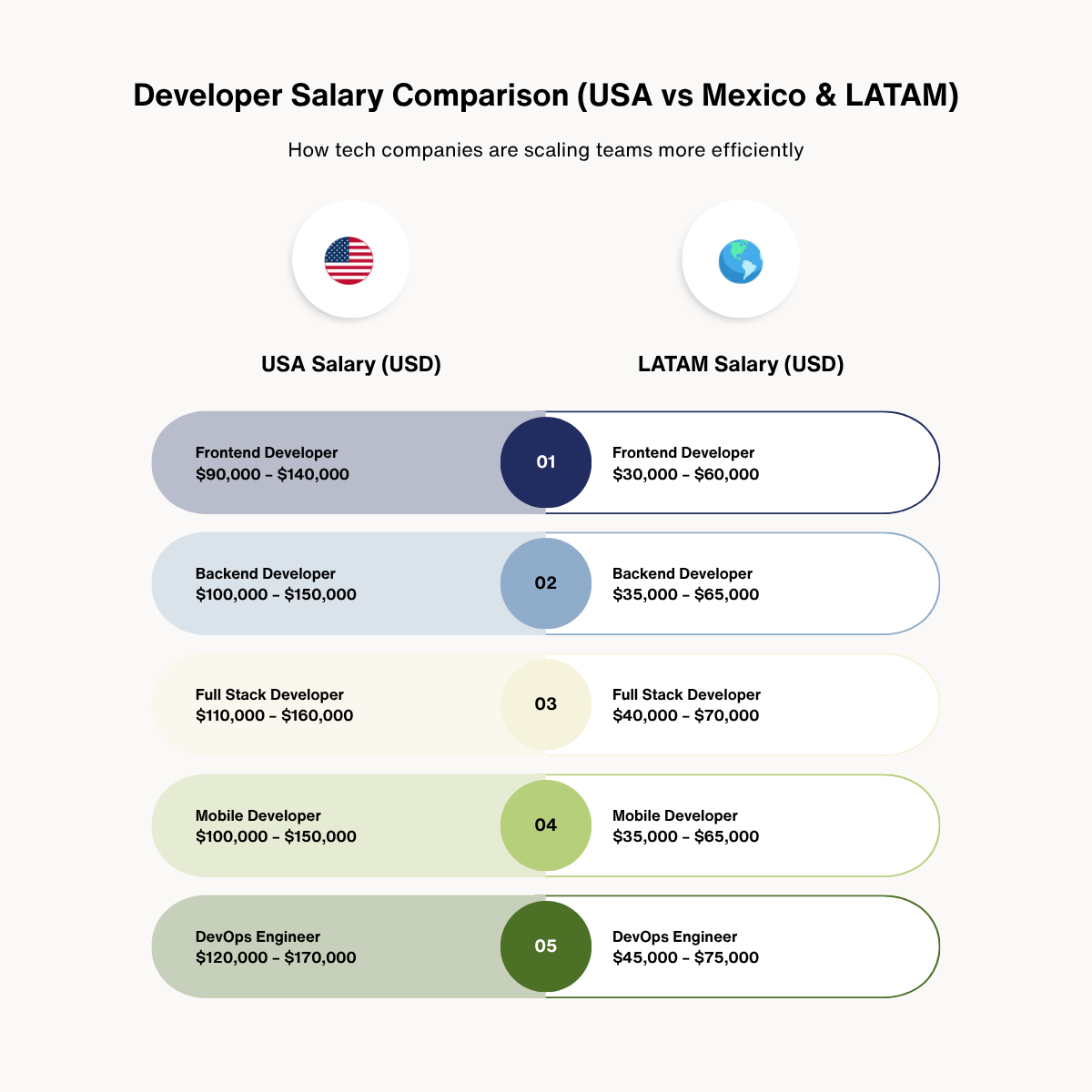
Typical annual salaries:
-
U.S. Developer: $100,000 – $160,000+
-
LATAM Developer: $30,000 – $70,000
This allows companies to:
-
Build larger teams
-
Extend runway
-
Increase development output
Without sacrificing quality.
Time Zone Alignment = Faster Development Cycles
This is one of the biggest advantages.
With developers working in similar time zones:
-
Standups happen in real-time
-
Issues are resolved faster
-
Feedback loops are shorter
-
Collaboration feels seamless
Compared to offshore models, this can dramatically increase velocity.
Flexibility That Tech Companies Need
Modern tech companies don’t always need full-time hires immediately.
They need flexibility:
-
Contract developers
-
Part-time specialists
-
Project-based support
-
Scalable team expansion
Nearshore hiring enables this without long-term overhead.
Why This Model Is Replacing Traditional Outsourcing
The shift is clear:
From:
-
Cost-focused outsourcing
-
Slow, asynchronous workflows
To:
-
Performance-focused hiring
-
Real-time collaboration
-
Scalable team structures
Mexico and LATAM sit perfectly in this new model.
FAQ
Are LATAM developers as skilled as U.S. developers?
Yes. Many have extensive experience working with international companies and modern tech stacks.
How do time zones compare?
Most LATAM countries align with U.S. and Canadian working hours, enabling real-time collaboration.
Is this only for startups?
No. Startups, agencies, and established tech companies are all adopting this model.
Conclusion
Hiring developers is no longer just about cost.
It’s about building teams that can move quickly, collaborate effectively, and scale sustainably.
For many U.S. and Canadian tech companies, Mexico and LATAM offer the ideal balance of:
-
Talent
-
Cost efficiency
-
Time zone alignment
-
Flexibility
And that’s why nearshore development is rapidly becoming the preferred approach.