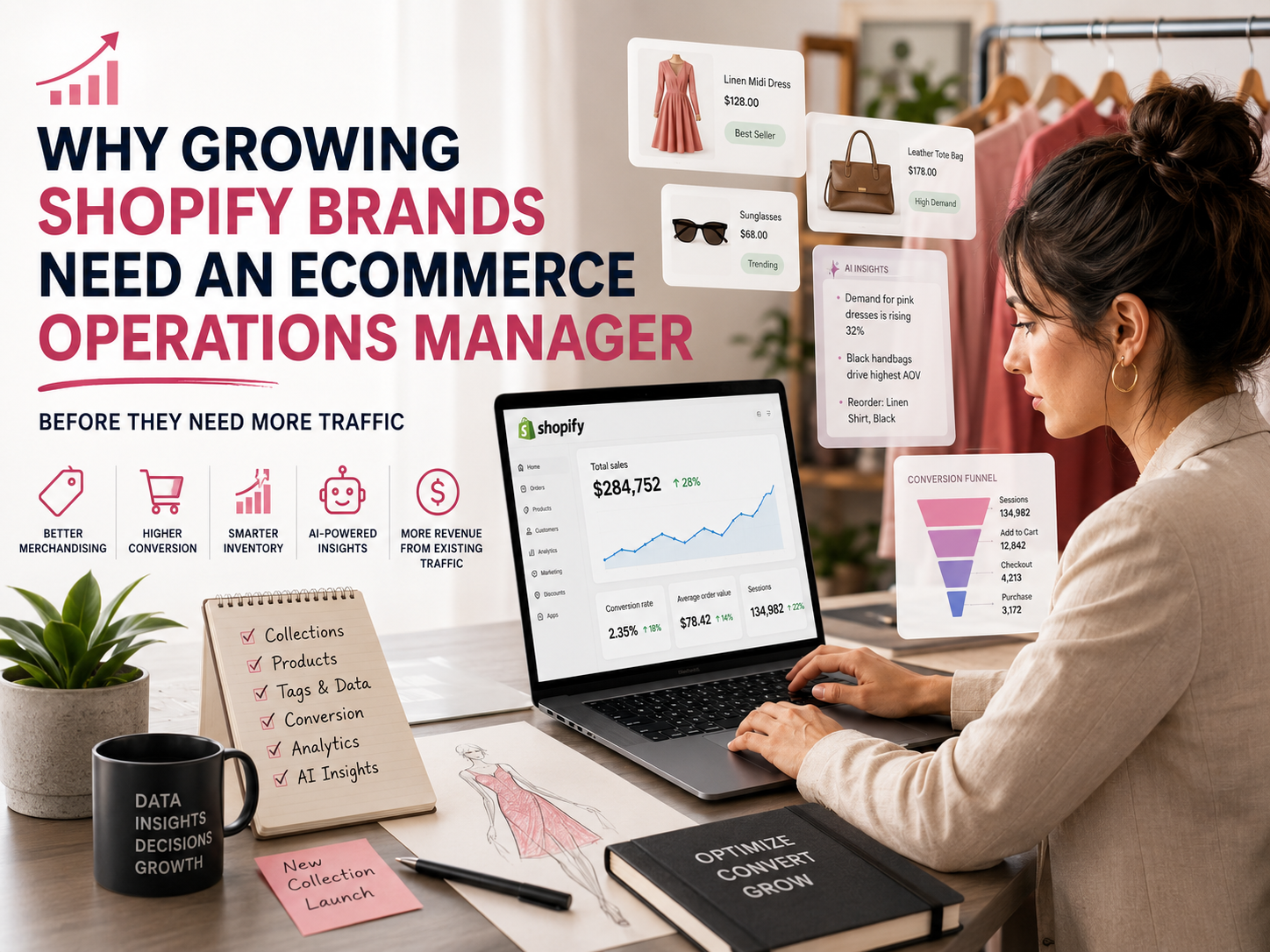
Why Growing Shopify Brands Need an Ecommerce Operations Manager Before They Need More Traffic
When ecommerce sales slow down or growth plateaus, most founders immediately look at traffic.
They increase Meta ad budgets.
They invest in influencer marketing.
They launch Google campaigns.
They hire agencies to generate more visitors.
But after speaking with a number of growing fashion and ecommerce brands recently, we've noticed a common pattern:
Many businesses don't have a traffic problem.
They have an ecommerce operations problem.
The reality is that thousands of Shopify stores are leaking revenue every day because nobody inside the business is actively managing the health, organization, merchandising, and performance of the store itself.
In many cases, increasing traffic simply sends more visitors into a store that isn't optimized to convert them.
Before investing another dollar into customer acquisition, founders should ask a more important question:
"Are we maximizing revenue from the traffic we already have?"
More Traffic Doesn't Automatically Mean More Sales
For many ecommerce brands, traffic becomes the default solution to every growth challenge.
Sales are down?
Buy more traffic.
Conversion rate drops?
Buy more traffic.
A new collection isn't performing?
Buy more traffic.
But traffic is only one part of the equation.
Revenue is ultimately determined by:
Revenue = Traffic × Conversion Rate × Average Order Value
Many founders focus heavily on the first variable while overlooking the other two.
If your store receives 100,000 monthly visitors but converts poorly, adding another 20,000 visitors may not solve the underlying issue.
The better opportunity may be improving conversion rates, product discoverability, merchandising, and customer experience.
Even small improvements can create significant revenue gains.
The Hidden Revenue Leaks Inside Many Shopify Stores
As brands grow, complexity increases.
New collections are added.
Seasonal launches happen faster.
Product catalogs expand.
Inventory becomes harder to manage.
Without someone owning ecommerce operations, small issues begin to compound.
Common examples include:
Poor Product Organization
Products are often:
-
Tagged inconsistently
-
Assigned to incorrect collections
-
Missing important attributes
-
Difficult for customers to find
When product data becomes disorganized, customer experience suffers.
Weak Collection Structures
Collections are often one of the highest-traffic areas of a Shopify store.
Yet many brands:
-
Never update sorting logic
-
Leave low-performing products at the top
-
Fail to prioritize best sellers
-
Ignore seasonal merchandising opportunities
Customers frequently abandon category pages because they cannot quickly find what they want.
Search and Navigation Problems
Store navigation directly impacts conversion.
Questions every brand should ask:
-
Can customers find products easily?
-
Are filters working correctly?
-
Are collections logically organized?
-
Are search results accurate?
Even small navigation issues can have a significant impact on revenue.
What Does an Ecommerce Operations Manager Actually Do?
This is where many founders become confused.
They assume they need:
-
A Shopify assistant
-
A virtual assistant
-
A store administrator
However, those roles typically focus on tasks.
What growing brands actually need is ownership.
An Ecommerce Operations Manager takes responsibility for the health and performance of the Shopify ecosystem.
Shopify Operations
Responsibilities include:
-
Product setup
-
Variant management
-
Collection organization
-
Navigation structure
-
Product data audits
-
Metafield management
-
Search optimization
The goal is simple:
Create a store that is organized, scalable, and easy to shop.
Ecommerce Merchandising
Great merchandising drives revenue.
An Ecommerce Operations Manager should constantly evaluate:
-
Best-selling products
-
Underperforming products
-
Collection performance
-
Product placement
-
Cross-selling opportunities
-
Upsell opportunities
Every product should have a purpose.
Every collection should support conversion.
Conversion Rate Optimization (CRO)
One of the most valuable responsibilities of this role is improving conversion.
This includes:
-
Reviewing customer journeys
-
Analyzing user behavior
-
Studying session recordings
-
Reviewing heatmaps
-
Improving product detail pages
-
Optimizing collection pages
-
Improving cart performance
The goal is not simply increasing traffic.
The goal is generating more revenue from existing traffic.
Why AI Is Making This Role More Important
Artificial intelligence is rapidly transforming ecommerce.
Today's brands have access to tools that can:
-
Forecast demand
-
Analyze customer behavior
-
Predict stock-outs
-
Identify declining products
-
Generate merchandising insights
This is incredibly valuable.
However, AI still requires human interpretation.
AI can tell you:
"This collection is underperforming."
A skilled Ecommerce Operations Manager can determine:
Why it's underperforming.
What should change.
How quickly changes should be implemented.
Which products should be promoted instead.
The future of ecommerce is not AI versus people.
It's AI supported by experienced operators.
Why Fashion Brands Need Better Inventory Intelligence
One of the most overlooked responsibilities of ecommerce operations is inventory analysis.
Founders often make buying decisions based on intuition.
The best ecommerce operators make decisions based on data.
Questions they help answer include:
-
Which products generate the highest profit?
-
Which SKUs should be reordered?
-
Which products should be discontinued?
-
Which colors consistently underperform?
-
Which products drive first-time purchases?
-
Which products generate repeat customers?
These insights directly impact profitability.
Signs Your Brand Needs an Ecommerce Operations Manager
You may be ready for this role if:
-
Your Shopify store has more than 100 products
-
You run paid traffic campaigns
-
You launch multiple collections annually
-
Conversion rates have stagnated
-
Inventory decisions feel reactive
-
Nobody owns merchandising
-
Product organization has become difficult to manage
If any of these sound familiar, the issue may not be traffic.
The issue may be operational oversight.
Why More Brands Are Hiring Nearshore Ecommerce Talent
Many growing brands are not ready for a $100,000+ ecommerce hire.
However, they still need expertise.
This is why many U.S. and Canadian businesses are turning to experienced ecommerce professionals from Mexico and LATAM.
These professionals can support:
-
Shopify management
-
Ecommerce operations
-
Merchandising
-
CRO
-
Inventory reporting
-
Data analysis
-
AI implementation
Whether part-time or full-time, they can provide immediate support while integrating directly into existing teams.
Final Thoughts
The next phase of ecommerce growth will not belong to brands that simply buy more traffic.
It will belong to brands that better understand the traffic they already have.
An Ecommerce Operations Manager helps create that advantage.
Because when someone owns merchandising, conversion, inventory intelligence, data quality, and store performance, growth becomes more predictable, more profitable, and more scalable.
And that's often worth far more than another advertising campaign.
FAQ
What does an Ecommerce Operations Manager do?
An Ecommerce Operations Manager oversees Shopify store performance, merchandising, conversion optimization, reporting, inventory insights, and customer experience improvements.
How is an Ecommerce Operations Manager different from a Shopify Admin?
A Shopify Admin performs tasks. An Ecommerce Operations Manager owns outcomes such as conversion rates, merchandising performance, and store optimization.
Can AI replace an Ecommerce Operations Manager?
AI can support reporting and analysis, but strategic decisions, merchandising choices, conversion optimization, and inventory planning still require human expertise.
When should a brand hire an Ecommerce Operations Manager?
Most brands should consider this role once product catalogs, collections, and traffic volumes become too complex for founders to manage directly.